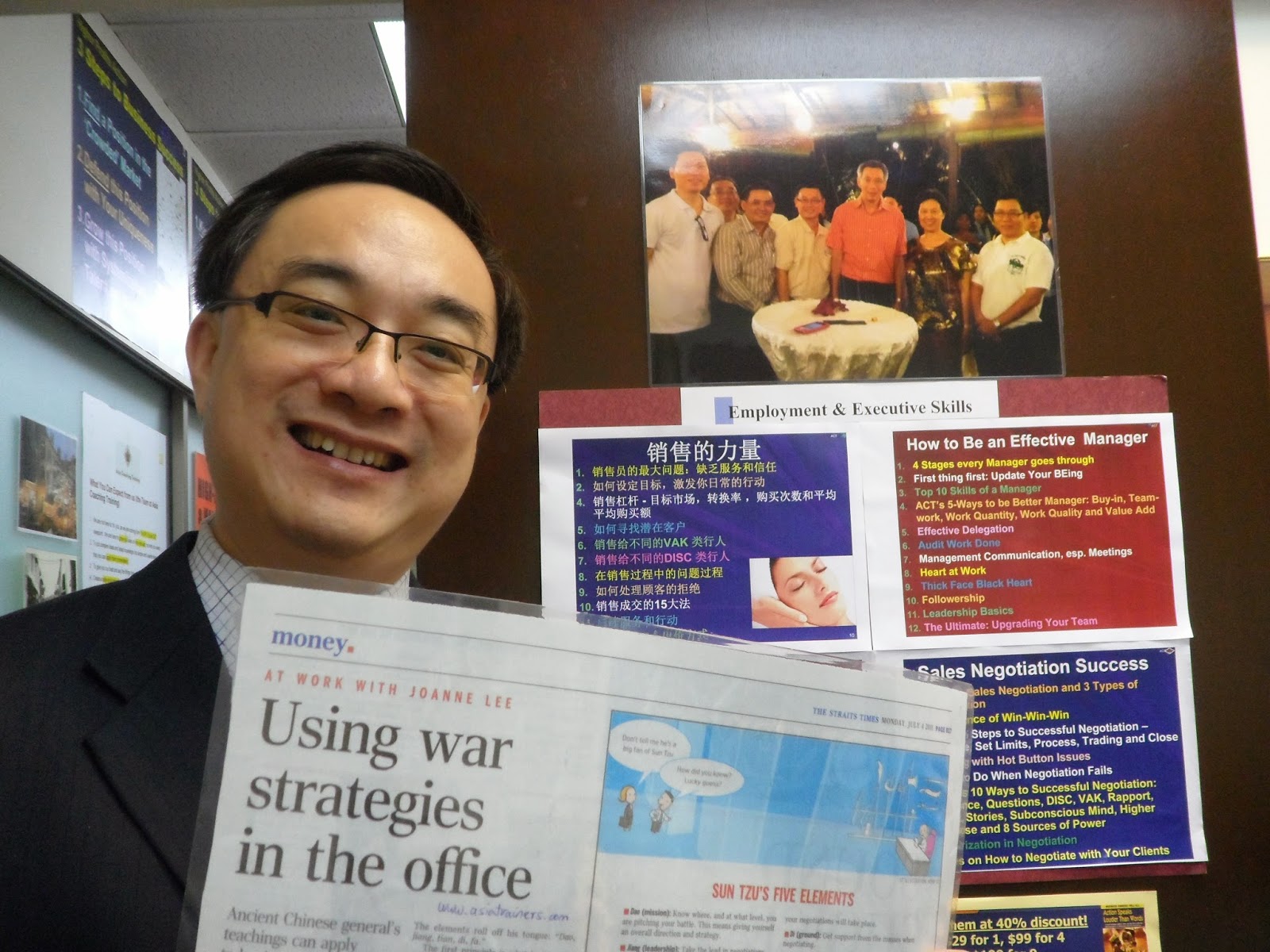
If You Want to Jump Down, Go to the Highest Floor

The little known secret from Sun Tzu's Art of War is simply Go High if you want to win big. There are 5 ways that you can go high:
  1. Reach customers at the highest level possible. Sometimes the highest level is the secretary.
  2. Pitch your product at a level that no other competitor can fight, like having a unique feature (eg Samsung flexible Yoom phone)
  3. Go beyond the benefits of your products and focus on your company's passion and strong belief, even if the market is not ready for it;
  4. Get the highest level in your company (eg MD) to approach the prospect, and look at the awe in their face!
  5. Instead of mentioning your strengths, mention all your weaknesses. Your prospect will be shocked that you're so upfront and he will think that the weaknesses will not pose much problems if you are sincere. Then show your confidence of resolving the weaknesses.
By Andy Ng, whose programs Sun Tzu Art of War for Sales was delivered also in Philppines, Malaysia and Chinatown. Whether you’re leading your sales team or working hard in your daily sales, come and join over 9,879 people in 7 countries and learn from 2,500 years of wisdom. The next run for Sun Tzu Art of War for Sales is on 5 Feb 2015 Thursday 9 amm. Hurry! Limited seats available. Get your entire sales team to attend for maximum effectiveness! Register via reply email or call Idah at 6225-1784. Or do it online at here..

Comments

Popular posts from this blog

The Secret Under the Mattress: Why would a 79-year Man Bet So Big on 4D?

It was 2007 when we discovered his secret. While moving my father’s mattress, we found them: heaps and heaps of Singapore Pools 4D tickets. They were stacked in layers, a paper trail of lost hopes. What shocked us most wasn’t just the volume, but the stakes. He wasn’t betting a few dollars for fun. He was punting hundreds of dollars per draw—nearly ten times a month. At the time, my siblings and I were furious. Our father was a 79-year-old retiree. We wondered, with a mix of anger and confusion, why a man at his stage of life would need to win such "big money." What was he going to do with the money? We saw it as a reckless habit, a sign of poor judgment in his final years.  Some of us would say, "If I were to give him money to buy 4D, why don't I use the money and buy 4D myself?  At least I have better discipline".  It has taken me two decades, and the experience of raising my own three grown-up children, to finally see the truth that was hidden under that matt...

Have You Found Your Sun Yi and Teresa Teng?

I n the long, unfolding history of the Chinese-language music scene, "The Moon Represents My Heart" 月亮代表我的心 stands as an unsurpassable milestone. Yet, the journey of this globally renowned masterpiece, a song that would eventually captivate the world, was fraught with setbacks: it was once dismissed as "trash" by its own creator and tossed into a wastebasket, later suppressed by official policy as a "banned song ," and initially failed to gain any traction when performed by two different singers. The dramatic turnaround in this song’s fate is not merely a musical legend; it offers a profound life lesson: the greatest stroke of luck in life is not about how perfect you are, but about encountering the "right people", those who truly understand you, support you, and help you realize your potential, at exactly the right moment. I. The First "Right Person": A "Talent Scout" Who Recognizes Your Worth In the early 1970s, composer T...

Head Bleeding when the Chair Falls

The Weight of Silence: What Were We Really Arguing About? My earliest memories are punctuated by the sound of shouting. In 1970, when I was barely 6 years old, I stood as a small witness to the fierce quarrels between my father and my late eldest brother Kah Yang (he passed away in 1971 at the age of 17). As I grew up, these contradictions became the soundtrack of our lives, usually centered around our family's shoe shop and clothing stalls in Chinatown. In the court of family opinion, the verdict was almost always the same: my father was "wrong." He was judged as a man who didn't fulfill his role, who wasn't "burdening" enough for the family’s success. But as I look back from the vantage point of 2026, I have to ask: Was that actually true? Let me finally put to rest what my father did right: the truths that were buried under decades of criticism: Unseen Labor: He worked grueling, long hours. I remember him hauling boxes of goods and equipment to set u...